
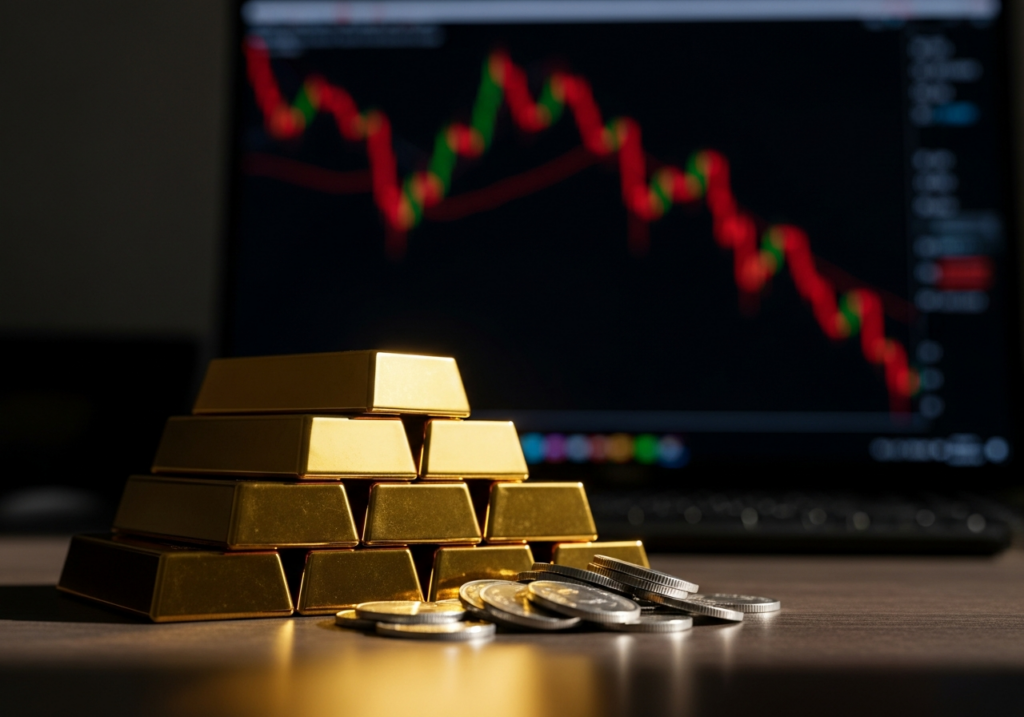
What happens to metals in a market crash? In most cases, precious metals such as gold and silver tend to hold their value better than stocks and may even rise, while industrial metals often decline alongside broader economic activity. The reason comes down to investor behavior, economic expectations, and each metal’s role in the financial system. During periods of extreme uncertainty, metals often display what investors call safe haven behavior, though the response can vary depending on the type of metal and the nature of the crisis.
To understand metals performance during a crisis, it helps to separate precious metals from industrial metals. Each reacts differently because they serve different purposes in the economy.
Precious Metals in a Market Crash: Gold and Silver
When financial markets unravel, the behavior of precious metals often diverges sharply from the assets falling around them — and understanding why reveals something important about how gold and silver actually function within a portfolio.
Gold: The Flight-to-Safety Asset
Gold’s resilience in a crisis is not accidental. Unlike equities, it carries no earnings risk. Unlike bonds, it is not a promise made by a government or corporation that could be downgraded, defaulted on, or debased. It exists outside the financial system in a way that most assets do not — and that distinction matters most precisely when confidence in the financial system begins to crack.
When systemic fear takes hold, capital tends to migrate toward gold. The mechanism is straightforward: as investors exit financial assets, demand for a reliable store of value rises, and gold prices typically follow.
History bears this out, though not without nuance. During the 2008 financial crisis, gold did not rise immediately — it fell in the early weeks, as forced liquidations and margin calls drove investors to sell whatever they could to raise cash. But once that liquidity shock passed, gold decoupled from the broader carnage and went on to reach record highs over the following years. The same pattern repeated in March 2020: a sharp, brief selloff driven by panic and liquidity needs, followed by a powerful and sustained recovery as fiscal stimulus flooded the system and uncertainty deepened.
The lesson is not that gold is immune to short-term selling pressure — it isn’t. The lesson is that its recovery tends to be both faster and more durable than most other assets in the aftermath of a crash.
Silver: Sharper Swings, Stronger Rebounds
Silver occupies a more complicated position. It shares gold’s monetary heritage and safe-haven appeal, but it carries an additional identity that gold does not: it is an industrial metal, consumed in manufacturing, electronics, and renewable energy infrastructure. That dual nature makes its behavior in a market crash less predictable — and more volatile.
When a financial crisis spills into a genuine economic contraction, silver faces pressure from two directions simultaneously. Investor fear may initially support it, but weakening industrial demand pulls in the opposite direction. The result is typically a more severe drawdown than gold experiences in the early stages of a selloff — silver tends to fall harder, faster, and with less cushion.
Yet that same sensitivity cuts both ways. Once stability begins to return and economic activity recovers, silver’s industrial demand reasserts itself alongside its monetary appeal, and the rebound can be sharp. For investors with the risk tolerance to hold through the volatility, silver’s swings can ultimately represent opportunity — but they require a steadier hand than gold demands.
Taken together, both metals tend to earn their place in a portfolio during a crash — not by being immune to short-term turbulence, but by recovering with purpose while other assets are still searching for a floor.
Industrial metals: copper and others
In contrast, metals like copper, aluminum, and nickel are closely tied to economic growth. When businesses slow production and construction declines, demand for these metals typically falls. Therefore, during a market crash driven by recession fears, industrial metals tend to decline.
This pattern reflects expectations about future activity. Copper, in particular, is often seen as a barometer of global growth. If markets anticipate reduced manufacturing and infrastructure spending, copper prices usually weaken.
There are exceptions. If a crisis is followed by aggressive government stimulus focused on infrastructure or green energy, industrial metals can recover quickly. Nevertheless, in the early stages of most equity market crashes, these metals typically face downward pressure.
Why metals sometimes fall initially
Investors are often surprised to see gold dip during the first phase of a crash. Yet this phenomenon is common. During severe market stress, liquidity becomes a priority. Investors sell what they can, not necessarily what they want to. Futures contracts, ETFs, and even physical positions may be liquidated to cover margin calls or raise cash.
However, once the forced selling subsides, the underlying reasons for owning precious metals often strengthen. Lower interest rates, expanded money supply, and fiscal stimulus can support gold prices. For this reason, gold’s longer-term response to crisis conditions frequently differs from its immediate reaction.
The role of interest rates and currency
Interest rates play a central role in metals performance during a crisis. Gold does not generate income. Consequently, when real interest rates fall, the opportunity cost of holding gold declines. If central banks cut rates aggressively or inflation expectations rise, gold can benefit.
Moreover, currency movements matter. Since gold is priced globally in U.S. dollars, a weaker dollar can support higher gold prices. In contrast, a strengthening dollar during a panic can temporarily pressure metals.
Not All Crashes Are Created Equal
One of the most common mistakes investors make when turning to precious metals in a downturn is treating all market crashes as interchangeable. They are not — and the nature of the crisis has a significant bearing on how gold and silver are likely to behave within it.
A financial system crisis — one where trust in banks erodes, sovereign debt comes under pressure, or currency stability is genuinely in question — tends to produce the strongest safe-haven response in precious metals. These are precisely the conditions gold was, in a sense, built for. When the integrity of the financial architecture itself is in doubt, assets that exist outside that architecture become disproportionately valuable.
A demand-driven recession tells a different story. If markets are falling primarily because growth is slowing, earnings are disappointing, or a cycle is turning — but the banking system remains intact and institutional confidence holds — gold’s response is often more measured. It may still outperform equities, but the dramatic flight-to-safety dynamic is less likely to fully materialize. Silver, given its industrial exposure, may face additional headwinds in this environment as economic activity contracts.
Geopolitical shocks occupy their own category: they can produce sudden, sharp moves in precious metals driven by fear and uncertainty, but those moves can also prove short-lived if the underlying financial system remains stable and the disruption resolves without broader economic damage.
The practical implication for investors is that context matters as much as the trade itself. Precious metals are not a guaranteed one-way bet when volatility strikes — they are a differentiated asset class whose behavior is shaped by the source of the instability, not merely its severity. Understanding that distinction transforms metals from a reflexive panic purchase into a considered, thesis-driven position — one held with clarity about what it is actually hedging against.
Portfolio diversification and retirement planning
For retirement investors, the key question is not whether metals will surge in every crash. Instead, it is how they can contribute to overall portfolio resilience.
Precious metals historically have low or negative correlation with stocks during extreme stress periods. As a result, allocating a modest portion of a retirement portfolio to metals may reduce overall volatility. This does not eliminate risk. Yet it can soften the impact of declines in traditional assets.
Furthermore, metals can act as a hedge against currency debasement or inflation that sometimes follows aggressive policy responses to a crash. Over a multi-decade retirement horizon, those policy cycles matter.
It is also important to consider liquidity needs. Metals can be volatile in the short term. Therefore, they should complement, not replace, diversified holdings such as equities, bonds, and cash reserves.
Short FAQ: What investors often ask
Do metals always go up in a market crash?
No, metals do not always rise immediately during a crash. In fact, they can fall in the early stages due to forced selling and liquidity demands. However, precious metals, especially gold, have often recovered and performed well as policy responses unfold and uncertainty persists. The timing and severity of the crisis influence the outcome.
Which metal performs best in a crisis?
Historically, gold has shown the most consistent safe haven behavior during financial crises. Silver can perform strongly as well but tends to be more volatile because of its industrial uses. Industrial metals like copper usually struggle during recession-driven crashes.
How much of a retirement portfolio should be in metals?
There is no universal percentage that fits everyone. Many cautious investors consider a modest allocation, often in the single digits to low teens, depending on risk tolerance and overall asset mix. The goal is diversification and wealth protection, not speculation on price spikes.
Are physical metals safer than metal ETFs during a crash?
Each format has advantages. Physical metals remove counterparty risk, which may appeal to investors concerned about systemic problems. ETFs, on the other hand, offer liquidity and ease of trading. The preference often depends on the investor’s comfort level, storage considerations, and long-term objectives.
Can metals protect against inflation after a market crash?
They can. In particular, gold has historically helped preserve purchasing power during periods of rising inflation and declining real interest rates. However, protection is not immediate or guaranteed in every cycle. Long-term policy trends and monetary conditions largely determine that outcome.
Ultimately, what happens to metals in a market crash depends on the type of metal, the cause of the downturn, and the policy response that follows. Precious metals often provide diversification and potential downside protection, while industrial metals reflect economic weakness. For retirement investors focused on wealth protection, understanding these differences can lead to more balanced and resilient portfolio decisions.