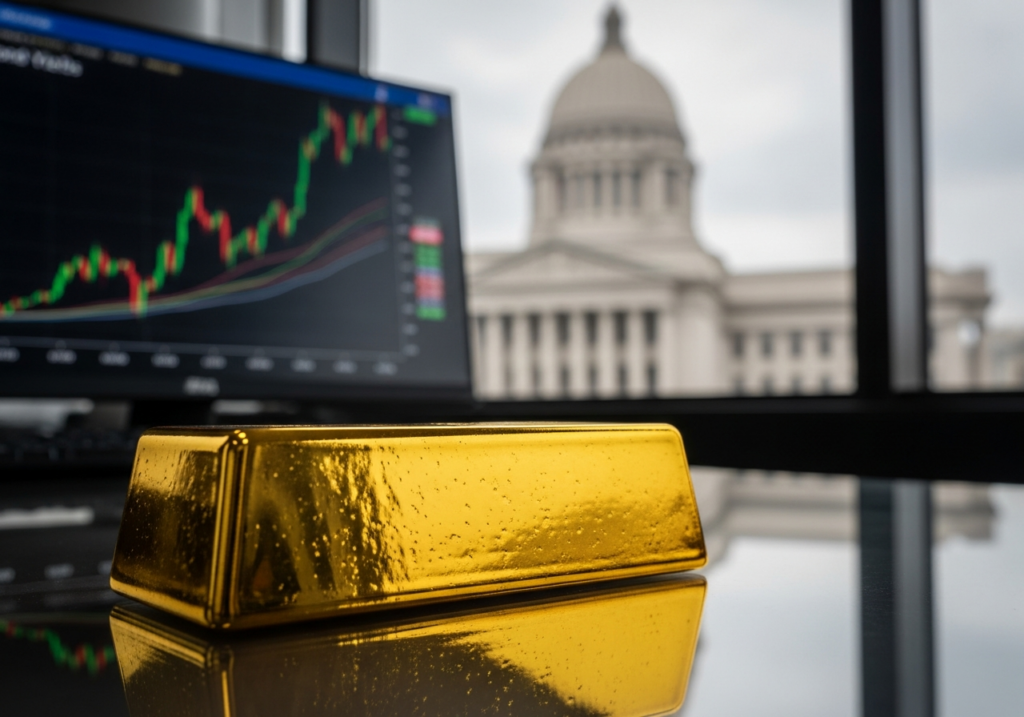
Interest rates affect gold prices primarily through opportunity cost, dollar strength, inflation expectations, and investor sentiment. In general, when interest rates rise, gold prices often face pressure. Conversely, when interest rates fall, gold tends to become more attractive. However, the relationship is not always immediate or mechanical. To understand it clearly, retirement investors need to look at how interest rates influence the broader economic environment and investor behavior.
Gold does not pay interest or dividends. Therefore, its appeal changes when the returns on interest-bearing assets change. When the Federal Reserve raises rates, bonds, savings accounts, and money market funds begin offering higher yields. As a result, the opportunity cost of holding gold increases. Investors may shift money away from gold into assets that generate income. This dynamic helps explain why the Fed rate impact on gold price often leans negative when rates are rising steadily.
The Role of Opportunity Cost
At the heart of how interest rates affect gold prices is the concept of opportunity cost. If a 10-year Treasury bond yields 1 percent, the sacrifice of holding gold instead of bonds is relatively small. However, if that same bond yields 5 percent, giving up that guaranteed income becomes more significant.
Therefore, rising real interest rates — which are rates adjusted for inflation — tend to weigh more heavily on gold. Gold competes not just with nominal rates but with real returns. When real returns become more attractive, conservative investors may prefer bonds or cash equivalents. Consequently, gold demand can soften.
In contrast, when real interest rates are low or negative, gold often becomes more appealing. If inflation is eroding the purchasing power of cash and bonds are not keeping up with price increases, gold may serve as a store of value. In other words, it is not simply high or low rates that matter, but whether those rates are outpacing inflation.
The Federal Reserve and Gold Prices
The Fed rate impact on gold price is closely watched by markets. When the Federal Reserve signals interest rate hikes, markets begin adjusting expectations immediately. Even before rates rise, gold may decline if investors anticipate tighter monetary policy. Furthermore, aggressive rate hikes often strengthen the U.S. dollar. Since gold is priced in dollars globally, a stronger dollar can make gold more expensive for foreign buyers. As a result, global demand may weaken, adding additional pressure on prices.
However, there are exceptions. If the Fed raises rates because inflation is running persistently high, gold may remain supported. Investors may doubt whether rate increases will be sufficient to contain inflation. In that case, gold can benefit despite rising rates. This is why examining economic context is essential rather than assuming a simple inverse relationship.
Interest Rates and Commodities More Broadly
The relationship between interest rates and commodities is complex, and gold is somewhat unique among them. Industrial commodities such as copper or oil often respond to economic growth expectations. If rates are rising because the economy is expanding, industrial commodities may perform well due to stronger demand.
Gold, in contrast, behaves partly as a currency substitute and partly as a financial asset. It is often treated as a hedge against uncertainty. Therefore, its response to interest rates can differ from other commodities. For example, if rates rise during a stable, growing economy with low inflation, gold may struggle. Yet if rates rise in response to financial instability or inflation concerns, gold can remain resilient. The context behind the rate move is crucial.
Real Rates Versus Nominal Rates
Retirement investors often focus on the headline interest rate. However, what truly matters for gold is the real rate. Real rates subtract inflation from nominal rates. If the Fed raises rates to 4 percent but inflation stands at 5 percent, the real rate is negative.
Negative real rates historically provide support for gold. Investors recognize that their purchasing power in fixed-income assets is shrinking. As a result, gold can retain or increase its appeal as a store of wealth.
Conversely, when inflation is under control and real rates move decisively positive, gold may lose momentum. Therefore, understanding inflation trends is just as important as following Federal Reserve policy.
Market Psychology and Expectations
In financial markets, expectations often matter more than the actual rate decision. If investors expect aggressive rate hikes and the Fed delivers less than anticipated, gold may rise on relief. Conversely, surprise tightening can trigger downward pressure.
Moreover, market psychology plays a powerful role. During times of economic stress, investors may turn to gold regardless of rate levels. Fear, uncertainty, and geopolitical risk can overshadow interest rate considerations.
For retirement investors, this means gold’s behavior cannot be reduced to a single metric. It sits at the intersection of monetary policy, inflation, currency values, and investor confidence.
How This Applies to Retirement Portfolios
For long-term retirement planning, gold is rarely used for income. Instead, it is typically viewed as a hedge against inflation, currency risk, or financial instability.
When interest rates are rising steadily and inflation is contained, gold may underperform income-producing assets. However, when real returns are low, inflation is persistent, or market volatility increases, gold may help offset risks within a diversified portfolio.
Ultimately, the relationship between interest rates and gold prices is dynamic rather than fixed. For this reason, investors should evaluate economic conditions holistically instead of reacting to rate changes alone.
FAQ
Does gold always fall when interest rates rise?
No. While rising interest rates often create headwinds for gold, the outcome depends on inflation and economic context. If rates rise but inflation remains higher, real rates may stay negative. In that case, gold can hold steady or even rise. In contrast, when rate hikes produce positive real returns and strengthen the dollar, gold typically faces pressure.
Why does the Fed rate impact gold price so quickly?
Gold markets are forward-looking. Traders adjust positions based on expectations of future Federal Reserve policy, not just current rates. Therefore, even hints from Fed officials can move gold prices before an official rate change occurs. Markets continuously price in anticipated economic shifts.
How do interest rates affect gold compared to other commodities?
Interest rates affect commodities differently. Industrial commodities often respond to growth and demand trends. Gold, however, behaves more like a financial asset and monetary alternative. It responds strongly to real interest rates, currency movements, and inflation expectations rather than purely to physical supply and demand.
What should retirement investors watch besides interest rates?
In addition to rate levels, investors should monitor inflation trends, real yields, Federal Reserve communication, and dollar strength. Furthermore, broader economic risks can influence gold’s role as a defensive asset. Taken together, these factors provide a clearer picture than interest rates alone.
Is gold a good investment during periods of falling interest rates?
Falling interest rates often support gold because the opportunity cost of holding non-yielding assets declines. Moreover, rate cuts sometimes signal economic weakness, which can increase demand for defensive assets. However, performance still depends on inflation, currency movements, and overall investor sentiment.
Understanding how do interest rates affect gold prices requires looking beyond a simple cause-and-effect formula. Interest rates shape inflation, currency values, and investor confidence. Consequently, gold responds to the broader monetary environment rather than to rate changes in isolation. For retirement investors, viewing gold within that broader framework leads to more informed, balanced decisions.
For those who want to go beyond the fundamentals, the Federal Reserve Bank of Chicago published a detailed research letter titled What Drives Gold Prices?, which examines the relationship between real interest rates, inflation expectations, and investor sentiment using data spanning five decades. It offers an empirical look at the forces that have shaped gold prices since 1971 and reinforces why no single factor — including interest rates — can fully explain gold’s behavior on its own. For retirement investors serious about understanding the true complexity behind gold pricing, it is well worth the read. The letter is freely available at chicagofed.org.