
A Silver IRA lets you hold physical silver in a retirement account while keeping the tax benefits of an IRA.
If you want to add silver to your retirement strategy, the key is understanding the rules. You need to know which silver products qualify, how the account is set up, where the metal is stored, and what fees you may pay.
If you have a workplace 401(k) or Thrift Savings Plan, you cannot hold physical silver in those accounts directly. You may, however, be able to roll eligible funds into a self-directed Silver IRA. You can also transfer funds from an existing traditional or Roth IRA.
This guide explains how a Silver IRA works, which metals are allowed, how to open one, what it costs, and the main benefits and drawbacks to consider before you decide.
What Is a Silver IRA?
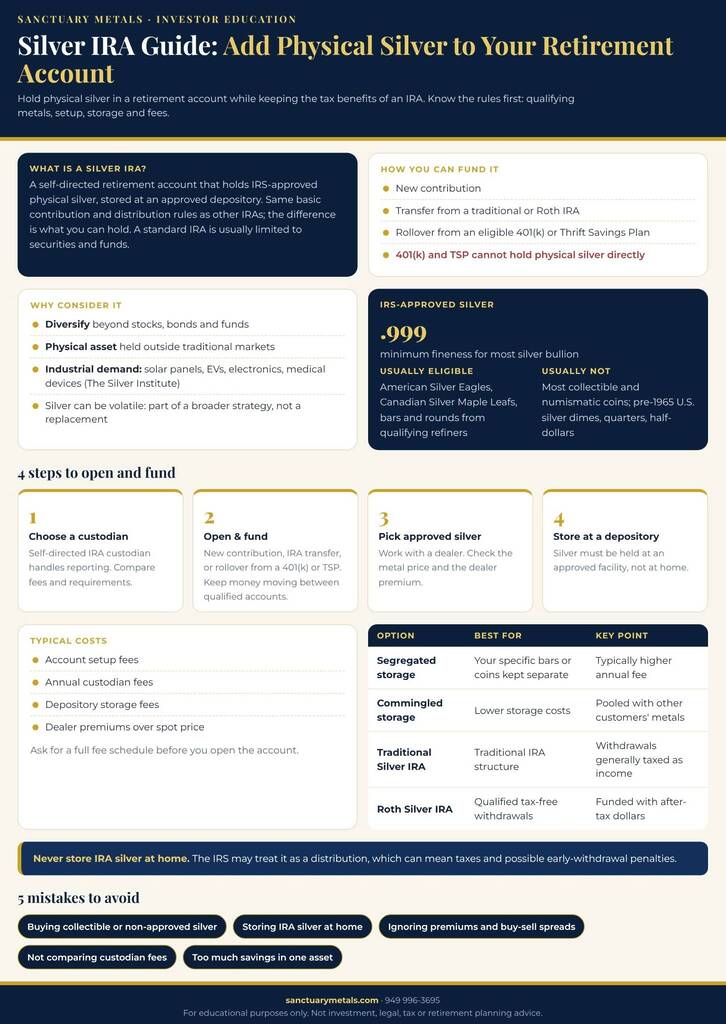
A Silver IRA is a self-directed retirement account that lets you hold IRS-approved physical silver instead of only traditional assets like stocks and bonds. The silver is held within the IRA and stored at an approved depository.
These Silver IRA accounts follow the same basic contribution and distribution rules as other individual retirement arrangements. The main difference is what you can hold inside the account.
With a standard IRA, your choices are usually limited to securities and funds. A self-directed IRA can also hold approved physical bullion.
Here’s how that compares with a standard retirement account.
Why Consider a Silver IRA Investment?
A Silver IRA gives you another way to diversify your retirement savings beyond stocks, bonds, and funds. Because silver is a physical asset, it may appeal to you if you want part of your portfolio held outside traditional financial markets.
Silver also has practical uses beyond investing. According to The Silver Institute, it is used in solar panels, electric vehicles, electronics, medical devices, and other industries. That industrial demand is one factor that can support long-term demand for the metal.
Silver can still be volatile, so it should be considered as part of a broader retirement strategy rather than a replacement for your other investments.
IRS-Approved Silver for Your IRA
You cannot put just any silver into an IRA. The metal has to meet IRS requirements. For most silver bullions, that means a minimum fineness of .999 pure. Before you buy, confirm that the product qualifies for IRA use.
Eligible Coins and Bars
Common eligible products include:
- Canadian Silver Maple Leafs
- Silver bars and rounds from qualifying refiners that meet the required purity standard
Most collectible and numismatic coins do not qualify. Pre-1965 U.S. silver dimes, quarters, and half-dollars generally do not meet the required fineness either.
If you are unsure about a coin or bar, confirm its eligibility with your custodian or precious metals dealer before buying it for your IRA.
How to Open and Fund a Silver IRA
Opening a Silver IRA follows a set process. You need a self-directed IRA custodian, eligible funds, approved silver, and qualified storage.
Step-by-Step Setup Process
Step 1: Choose a self-directed IRA custodian
The custodian administers your account and handles the required reporting. Compare fees, services, and account requirements before you choose one.
Step 2: Open and fund the account
You may be able to fund the IRA through a new contribution, a transfer from another IRA, or a rollover from an eligible workplace retirement plan such as a 401(k) or Thrift Savings Plan.
A direct transfer or rollover keeps the money moving between qualified accounts without being paid directly to you.
Step 3: Choose IRS-approved silver
Work with a dealer to select eligible coins or bullions. Check both the metal price and the dealer premium before you buy.
Step 4: Send the silver to an approved depository
Your silver must be stored through an approved facility rather than kept at home.
Once the account is set up, your ongoing costs will depend on your custodian, dealer, and storage option.
Silver IRA Costs and Storage Options
A Silver IRA usually costs more to maintain than a standard brokerage IRA because you are dealing with a physical asset.
Common costs include:
- Account setup fees
- Annual custodian fees
- Depository storage fees
- Dealer premiums over the spot price of silver
Ask for a complete fee schedule before opening the account so you know what you will pay upfront and each year.
Fees to Understand Before You Invest
Your storage choice can also affect the cost.
With commingled storage, your silver is stored with metals belonging to other customers. When you take a distribution, you generally receive the same type and quantity of metal rather than the exact bars or coins originally purchased.
With segregated storage, your specific metals are stored separately. This option usually costs more.
| Option | Best For | Key Consideration |
| Segregated storage | You want your specific bars or coins kept separately | Typically has a higher annual fee |
| Commingled storage | You want to keep storage costs lower | Metals are pooled with other customers’ holdings |
| Traditional Silver IRA | You want a traditional IRA structure | Withdrawals are generally taxed as income |
| Roth Silver IRA | You want qualified tax-free withdrawals | Funded with after-tax dollars |
The silver in your IRA must stay with an approved depository. Keeping IRA-owned silver at home can cause the IRS to treat it as a distribution, which may result in taxes and possible early-withdrawal penalties.
Common Mistakes to Avoid When You Buy Silver for an IRA
A few mistakes can create unnecessary costs or tax problems. Before you buy, watch for these:
- Buying collectible or non-approved silver
- Trying to store IRA-owned silver at home
- Ignoring dealer premiums and buy-sell spreads
- Choosing a custodian without comparing fees
- Putting too much of your retirement savings into one asset
Knowing the rules before you buy can help you avoid problems later.
Frequently Asked Questions
1. Is a Silver IRA a good investment?
It depends on your goals, risk tolerance, and overall retirement strategy. Silver can add diversification, but its price can be volatile, it does not produce income, and a physical-metal IRA comes with additional fees.
2. How much silver do I need to start a Silver IRA?
The IRS does not set one universal minimum for opening a Silver IRA. However, individual custodians and precious metals dealers may have their own minimum investment requirements. So, ask about minimums before opening the account.
3. Can I roll over my 401(k) or existing IRA into a Silver IRA?
You can move eligible funds from a 401(k) or Thrift Savings Plan into a Silver IRA through a rollover. Funds from an existing IRA may also be transferred to a self-directed IRA. When handled as a qualifying direct rollover or transfer, the movement of funds generally does not create an immediate tax or early-withdrawal penalty.
4. Can I store Silver IRA metals at home?
No. Silver held in an IRA must be stored through an approved depository. Taking possession of IRA-owned silver yourself can be treated as a distribution and may lead to taxes and, depending on your age and circumstances, an early-withdrawal penalty.
5. What silver products are eligible for a Silver IRA?
Eligible silver generally has to meet the IRS purity requirement. Common examples include American Silver Eagles, Canadian Silver Maple Leafs, and qualifying silver bars and rounds from approved refiners. So, always confirm eligibility before making a purchase.
6. Are there taxes or penalties on a Silver IRA?
With a traditional IRA, taxable withdrawals are generally treated as ordinary income. Qualified withdrawals from a Roth IRA can be tax-free. Taking money or metals out before age 59½ may also result in a 10% early-withdrawal penalty unless an exception applies.
Final Thoughts
A Silver IRA lets you add physical silver to a tax-advantaged retirement account. It can give you more diversification, but it also comes with added costs, storage requirements, and price volatility.
Before opening one, look at the full picture: the custodian fees, storage costs, dealer premiums, IRA rules, and how much silver you want in your overall retirement portfolio.
If you want help reviewing your options, Sanctuary Metals can explain the setup process, eligible metals, and account requirements before you decide how to proceed.
Contact us today to start your precious metal IRA.