
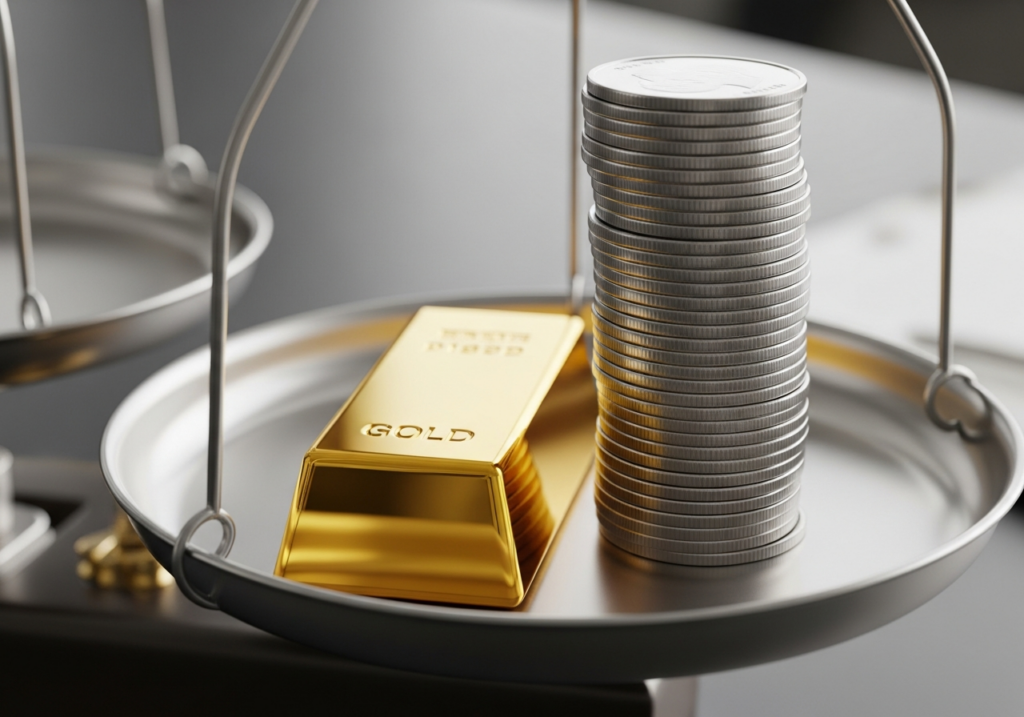
The gold/silver ratio is one of the most widely tracked metrics in precious metals investing. It measures how many ounces of silver are needed to purchase one ounce of gold — and for retirement investors, it offers a practical lens for evaluating relative value between two of the world’s most enduring assets.
If gold trades at $2,400 per ounce and silver trades at $30 per ounce, the gold/silver ratio is 80:1. That means 80 ounces of silver carry the same market value as a single ounce of gold. Simple to calculate, yet rich with insight when interpreted correctly.
Understanding the Gold/Silver Ratio and What It Means
The meaning of the gold/silver ratio goes well beyond basic arithmetic. It reflects how the market values gold relative to silver at any given moment — and that relationship shifts constantly based on economic conditions, investor behavior, and industrial trends.
Gold is widely regarded as a monetary metal and a long-term store of value. Silver, by contrast, plays a dual role: it functions both as a monetary asset and a critical industrial commodity used in electronics, solar panels, and medical devices. Because of this fundamental difference, the two metals do not always move in lockstep.
Historically, governments once fixed the ratio near 12:1 or 15:1. Today it floats freely on global markets. Over the last century, the ratio has ranged from below 20 to above 100, with long-run averages typically cited in the 50–70 range.
During periods of economic stress or financial uncertainty, investors tend to rotate into gold as a safe-haven asset. Gold prices may rise faster than silver, pushing the ratio higher. Conversely, during periods of strong economic growth and rising manufacturing activity, silver demand can outpace gold demand, compressing the ratio.
Understanding these dynamics helps investors determine which metal is relatively undervalued at any given time — a key input for disciplined allocation decisions.
How to Calculate the Gold/Silver Ratio
The formula is straightforward:
Gold/Silver Ratio = Gold Spot Price ÷ Silver Spot Price
Example:
- Gold price: $2,400 per ounce
- Silver price: $30 per ounce
- Gold/Silver Ratio: 2,400 ÷ 30 = 80:1
Because both metals trade continuously during market hours, the ratio updates in real time. Most financial news outlets and bullion dealers display it alongside current spot prices.
That said, the number itself is only half the picture. Interpreting the ratio meaningfully requires context — specifically, how today’s reading compares to long-term historical averages, and what broader economic forces are driving it.
Why the Gold/Silver Ratio Matters to Retirement Investors
For long-term investors focused on retirement, the gold/silver ratio serves as a strategic perspective tool rather than a short-term trading signal. It does not predict price movements. It does, however, help frame rational decisions about relative value.
When the ratio is historically high, silver may be undervalued relative to gold. This can prompt investors to increase silver exposure within their precious metals allocation. When the ratio is historically low, gold may represent better relative value.
Retirement planning is fundamentally about capital preservation and purchasing power over time. Gold has a centuries-long track record as a wealth-preservation asset. Silver offers higher growth potential but comes with greater price volatility. Tracking the ratio helps investors calibrate their exposure to each metal based on where it stands in its historical range.
Investors holding physical bullion inside a self-directed IRA sometimes use the ratio as a rebalancing trigger — shifting between gold and silver holdings over time without adding new capital. This strategy demands patience, low transaction costs, and careful tax planning, particularly in taxable accounts where metal sales can trigger capital gains.
What Factors Influence the Gold/Silver Ratio?
Several key drivers cause the ratio to rise or fall over time.
1. Investor Sentiment and Safe-Haven Demand During periods of financial crisis, geopolitical uncertainty, or market volatility, investors typically favor gold for its perceived stability. Capital flows into gold faster than silver, pushing the ratio higher. The 2020 peak above 120:1 is a prime example.
2. Industrial Demand for Silver Silver’s widespread use in manufacturing — including semiconductors, photovoltaic solar panels, and medical equipment — means industrial cycles directly affect its price. When global manufacturing expands, silver demand can surge, pulling the ratio lower.
3. Mining Supply Dynamics Silver is frequently a byproduct of copper, lead, and zinc mining. Changes in base-metal production can inadvertently alter silver supply, creating price pressure independent of direct silver demand. Gold mining, by contrast, is more isolated from these dynamics.
4. Monetary Policy and the U.S. Dollar Precious metals broadly respond to interest rate expectations, inflation data, and U.S. dollar strength. Because gold is more closely tied to monetary concerns — functioning as an alternative to fiat currency — it tends to react more strongly to central bank policy shifts. This asymmetric sensitivity affects the ratio regularly.
5. Speculative Activity and ETF Flows The growth of precious metals ETFs has made it easier for institutional and retail investors to gain exposure to both metals rapidly. Large speculative flows can amplify short-term ratio swings beyond what fundamentals alone would justify.
Using the Gold/Silver Ratio as a Long-Term Investment Strategy
For retirement-focused investors, the gold/silver ratio works best as one component of a broader allocation framework — not a standalone timing system.
A common disciplined approach works as follows:
- When the ratio rises well above its historical average (e.g., above 80–90), gradually increase silver exposure relative to gold.
- When the ratio falls significantly below historical norms (e.g., below 40–50), consider rebalancing toward gold.
In theory, this approach allows investors to accumulate more total ounces of precious metals over time without deploying additional capital — simply by rotating between two assets within the same portfolio sleeve.
Important considerations before implementing this strategy:
- Transaction costs: Buying and selling physical bullion involves dealer premiums, storage fees, and shipping costs that can erode gains.
- Tax consequences: In taxable accounts, exchanging one metal for another is a taxable disposal event that may trigger capital gains. In a self-directed IRA, these tax consequences are typically deferred, making it a more efficient venue for ratio-based rebalancing.
- Patience required: The ratio can remain elevated or depressed for extended periods. Investors must be prepared for the possibility that a correction does not materialize quickly.
Ultimately, the ratio is most valuable as a framework for disciplined, unemotional decision-making — especially during periods of market stress when impulsive moves are most tempting.
Historical Gold/Silver Ratio: Context and Benchmarks
| Era | Approximate Ratio |
|---|---|
| Ancient Rome / Biblical times | 12:1 – 15:1 |
| 19th-century bimetallism (U.S.) | 15:1 – 16:1 |
| 20th-century average | 40:1 – 50:1 |
| Modern long-run average (1970–present) | 55:1 – 70:1 |
| 2020 peak (COVID-19 crisis) | ~125:1 |
| Recent range (2022–2024) | 75:1 – 90:1 |
These benchmarks help investors assess whether the current ratio appears stretched or compressed relative to history. No single number defines “normal,” but extreme readings — especially above 90:1 or below 40:1 — have historically attracted mean-reversion attention from experienced precious metals investors.
Frequently Asked Questions About the Gold/Silver Ratio
What is a good gold/silver ratio to buy silver?
There is no universally agreed threshold, but many experienced investors view ratios above 80:1 as a signal that silver is historically cheap relative to gold. Readings above 90–100:1 have been relatively rare and have often preceded periods of silver outperformance. That said, “historically cheap” does not guarantee near-term price recovery — patience and a long investment horizon are essential.
Does a high gold/silver ratio mean silver will outperform gold?
Not necessarily, and not immediately. A high ratio indicates silver is relatively inexpensive compared with gold at that moment in time. Markets can remain mispriced for months or years before correcting. Silver may outperform if industrial demand strengthens, if speculative interest returns, or if inflation drives broad precious metals demand. But there is no automatic trigger. Avoid treating a high ratio as a guaranteed buy signal.
Why is silver more volatile than gold?
Two structural factors explain silver’s greater volatility. First, silver’s total market capitalization is a fraction of gold’s, meaning smaller capital flows can produce larger percentage price swings. Second, silver’s dual role as both an industrial input and a monetary asset means it responds to a wider set of economic variables — manufacturing cycles, technology trends, and investor sentiment simultaneously. Gold, functioning primarily as a store of value, moves more steadily in comparison.
Should retirement investors hold both gold and silver?
For most retirement investors building a precious metals allocation, holding both metals provides meaningful diversification within that asset class. Gold offers relative stability and is well-suited for wealth preservation. Silver offers higher potential returns alongside greater short-term volatility. The ideal mix depends on your time horizon, risk tolerance, and overall portfolio construction — the ratio is one input into that decision, not the whole answer.
What does the gold/silver ratio tell us about the economy?
The ratio functions as a soft economic sentiment indicator. A rising ratio typically signals defensive positioning, with investors favoring gold’s safe-haven characteristics during uncertainty. A falling ratio often reflects greater confidence in economic growth and expanding industrial demand for silver. Used alongside other indicators — inflation data, interest rates, employment figures, and currency trends — the ratio adds a useful dimension to macroeconomic analysis, though it should never be used in isolation.
How often does the gold/silver ratio change?
The ratio updates continuously during market hours because both gold and silver trade on global spot markets around the clock. Day-to-day fluctuations of one to three points are common. Larger structural moves — shifts of 10, 20, or more points — typically develop over weeks or months in response to major economic events, policy changes, or sustained shifts in industrial demand.
Key Takeaways: Gold/Silver Ratio Explained
Understanding the gold/silver ratio equips investors with a meaningful benchmark for assessing relative precious metals values over time. While it cannot predict exact price movements or market turning points, it provides a disciplined, data-driven framework for thinking about portfolio balance between two of history’s most enduring stores of value.
For retirement investors in particular, the ratio is most powerful when used consistently, patiently, and alongside a broader strategy that accounts for risk tolerance, tax efficiency, and long-term financial goals. A high ratio may highlight a potential opportunity in silver. A low ratio may warrant greater attention to gold. In both cases, the decision to act should be grounded in your overall plan — not in short-term speculation.
Precious metals investing involves risk, including the potential loss of principal. This article is for educational purposes only and does not constitute investment or tax advice. Consult a qualified financial advisor before making investment decisions.