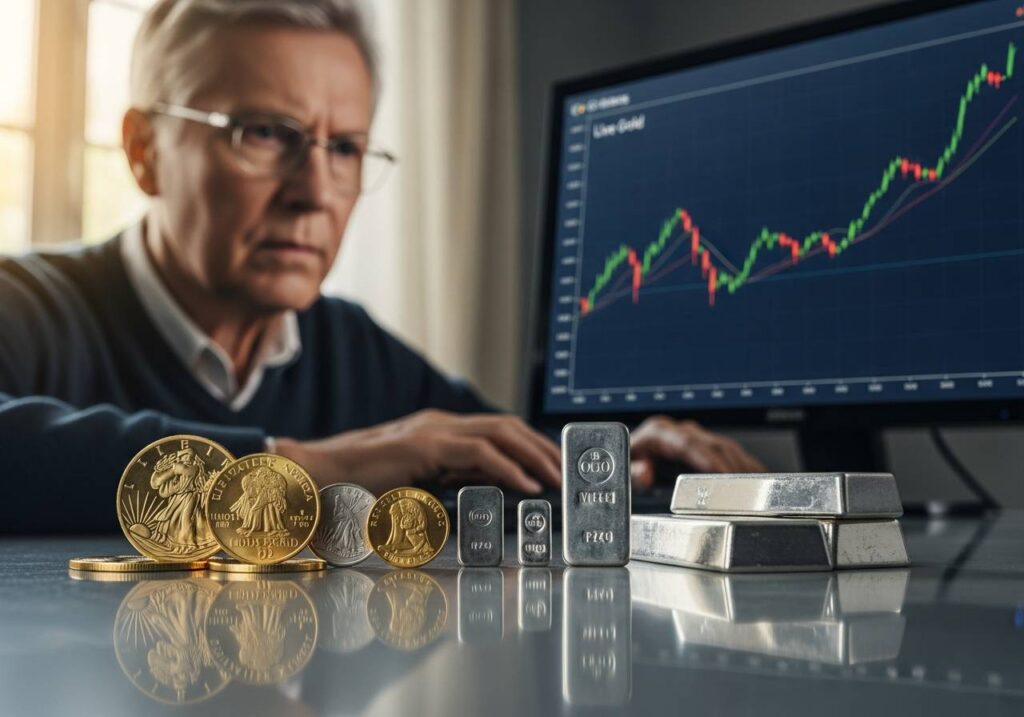
Many retirement investors eventually ask, why do gold and silver prices change? The short answer is that gold and silver prices move because of shifts in supply and demand of precious metals markets, changes in interest rates, inflation expectations, currency values, global economic conditions, and investor sentiment. These metals trade in active global markets, and their prices adjust constantly as buyers and sellers respond to new information.
Understanding the forces behind those price changes can help retirement investors make more thoughtful decisions. Gold and silver are often viewed as long-term stores of value, yet they are still influenced by regular market dynamics.
The Role of Supply and Demand in Precious Metals
At the most basic level, gold and silver prices change because of supply and demand precious metals fundamentals.
On the supply side, production depends on mining output, recycling activity, and existing above-ground inventories. Gold mining increases only gradually, since opening new mines takes years of exploration, permitting, and capital investment. Therefore, supply tends to grow slowly and predictably. Silver, in contrast, is often produced as a byproduct of copper, lead, and zinc mining. As a result, silver supply may fluctuate based on demand for other industrial metals.
Demand is more varied. Gold demand comes from jewelry buyers, central banks, technology manufacturers, and investors. Central banks, in particular, can have meaningful influence when they increase or decrease their reserves. Silver demand includes similar sources but has a larger industrial component, especially in electronics, medical uses, and solar panels.
When demand rises faster than supply, prices typically move higher. Conversely, if demand weakens or supply increases unexpectedly, prices may decline. However, supply and demand are only part of the story.
Interest Rates and Inflation Expectations
Interest rates are one of the most important market drivers gold investors should watch. Gold and silver do not pay interest or dividends. In periods when interest rates are high, investors can earn attractive returns from bonds or cash instruments. Consequently, the opportunity cost of holding precious metals increases, which can place downward pressure on prices.
On the other hand, when interest rates are low or falling, gold and silver often become more attractive. The income sacrificed by holding metals is smaller, so investor demand may increase.
Inflation expectations also play a central role. Gold, in particular, has historically been viewed as a hedge against inflation. When investors believe that purchasing power is declining, demand for gold can rise. As a result, prices may increase even before official inflation numbers fully reflect the trend.
Yet it is important to distinguish between actual inflation and expectations of future inflation. Markets often move on what investors anticipate, not just on current data.
The Strength of the U.S. Dollar
Gold and silver are generally priced in U.S. dollars. Therefore, movements in the US dollar often influence metal prices.
When the dollar strengthens, gold and silver can become more expensive for buyers using other currencies. This may reduce global demand, leading to lower prices in dollar terms. In contrast, when the dollar weakens, metals often rise because they become more affordable internationally and because investors may seek protection from currency erosion.
For retirement investors, this relationship highlights why precious metals are sometimes used as a diversification tool. They tend to respond differently than paper assets during periods of currency volatility.
Economic Uncertainty and Investor Sentiment
Gold and silver prices are also influenced by investor psychology. In times of economic stress, geopolitical tensions, or financial market instability, investors often move toward what they perceive as safe-haven assets. Gold frequently benefits from this behavior. Therefore, even if supply and demand precious metals fundamentals have not changed significantly, prices can rise due to heightened uncertainty.
Silver sometimes follows gold in these risk-driven moves. However, because silver has a larger industrial component, it may behave differently during economic slowdowns. For example, if manufacturing declines, silver demand could weaken despite broader financial concerns.
Investor sentiment can change quickly. As a result, prices may experience sharp short-term swings. Nevertheless, long-term trends are usually tied to fundamental factors such as monetary policy, inflation, and global growth.
Central Bank Policy and Monetary Expansion
Gold and silver prices are also influenced by investor psychology. In times of economic stress, geopolitical tensions, or financial market instability, investors often move toward what they perceive as safe-haven assets. Gold frequently benefits from this behavior, and the case for caution remains strong. The World Economic Forum’s Global Risks Report 2026 identifies geopolitical conflict, economic instability, and systemic financial shocks among the most pressing near-term threats facing the global economy — precisely the kinds of conditions that have historically driven investors toward precious metals. Therefore, even if supply and demand fundamentals have not changed significantly, prices can rise due to heightened uncertainty.
Silver sometimes follows gold in these risk-driven moves. However, because silver has a larger industrial component, it may behave differently during economic slowdowns. For example, if manufacturing declines — a realistic outcome in several of the risk scenarios outlined in the WEF report — silver demand could weaken despite broader financial concerns.
Investor sentiment can change quickly. As a result, prices may experience sharp short-term swings. Nevertheless, long-term trends are usually tied to fundamental factors such as monetary policy, inflation, and global growth.
Market Liquidity and Trading Activity
In addition to fundamentals, gold and silver prices change because of trading activity in futures markets, exchange-traded funds, and other financial vehicles. Large institutional investors can move in and out of precious metals quickly. Therefore, short-term price swings may reflect speculative positioning rather than underlying physical shortages or surpluses.
However, over time, prices tend to reflect broader economic conditions. Short-term volatility does not necessarily undermine the long-term role precious metals can play in a diversified retirement portfolio.
FAQ Section
Why do gold and silver prices change daily?
Gold and silver trade in global markets that operate nearly around the clock. Prices adjust constantly based on new information about interest rates, inflation data, currency movements, geopolitical events, and investor activity. Even small shifts in expectations can prompt buying or selling. As a result, daily price movements are common and often reflect sentiment rather than dramatic changes in physical supply.
Is silver more volatile than gold?
Yes, silver is generally more volatile than gold. In particular, the silver market is smaller, meaning that changes in investment demand can have a larger impact on price. In addition, silver’s industrial demand makes it more sensitive to economic cycles. During economic expansions, silver may outperform gold. However, during downturns, it can decline more sharply.
How do inflation and recession fears affect precious metals differently?
Inflation fears often support gold prices because investors seek protection against declining purchasing power. Silver may also benefit, but its industrial demand can moderate that effect. In contrast, during recessions, gold often performs well as a safe-haven asset. Silver’s response can be mixed. If industrial production falls significantly, silver demand may weaken, even if financial uncertainty supports investment demand.
Do gold and silver always move in the same direction?
They often move in the same general direction, but not always to the same degree. Gold is more directly influenced by monetary policy and central bank activity. Silver is affected by those factors as well, yet it is also tied to global manufacturing trends. Consequently, there are periods when one metal outperforms the other depending on economic conditions.
Ultimately, understanding why gold and silver prices change requires looking at both basic supply and demand precious metals forces and broader economic trends. For retirement investors, recognizing these market drivers gold and silver respond to can lead to more informed, balanced decisions rather than reactive ones.